Fighter pilots learn best against an aircraft that does not fly like their own. For decades the U.S. Navy and Marine Corps used the F-5 Tiger II for that job, and the type became better known in American skies as a training opponent than as a front-line fighter.
Why a small jet makes a good opponent
An adversary aircraft has one job: to give pilots a realistic opponent that flies differently from their own aircraft. This is called dissimilar air combat training. The F-5 suited it well. It is small and hard to spot, it maneuvers well, and its twin J85 engines and simple systems keep each flight hour cheap. The same qualities that made it attractive to smaller air forces made it practical for squadrons that fly hundreds of training sorties a year.
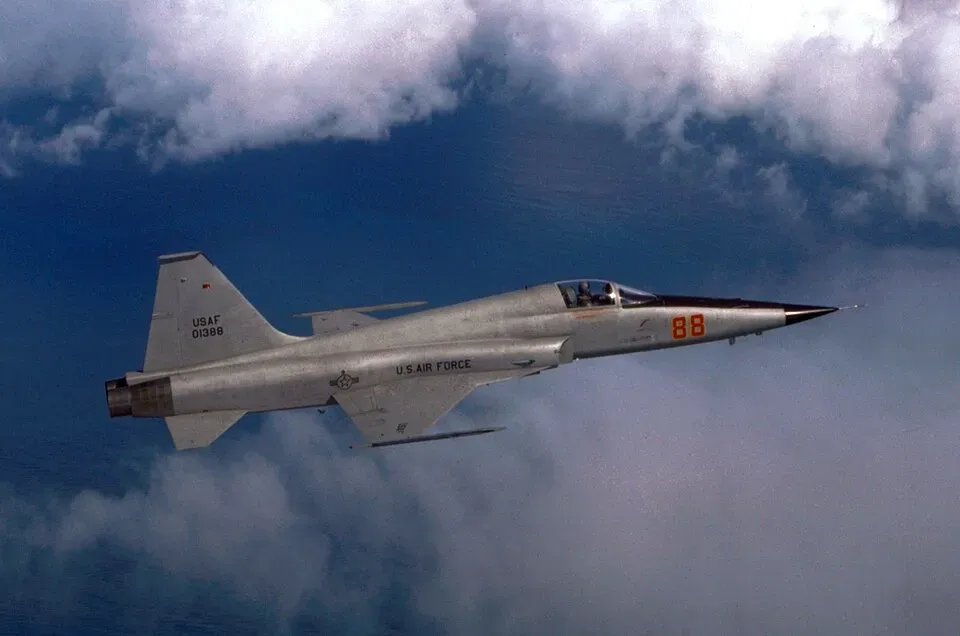
The adversary role is also where the F-5 met popular culture. Navy Fighter Weapons School jets wore Warsaw Pact-style camouflage, and the type later stood in for the fictional "MiG-28" on screen.
The Swiss connection
By the early 2000s the Navy's own F-5Es and F-5Fs were wearing out. The solution came from Switzerland, which had bought 110 Tigers in the 1970s: 98 single-seat F-5Es and 12 two-seat F-5Fs (NAVAIR's article counts all 110 as F-5Es; the split is on the Switzerland profile) and flown them lightly. In what NAVAIR called a reverse Foreign Military Sales program, the Navy bought 44 former Swiss jets over six years for $50 million.[1]
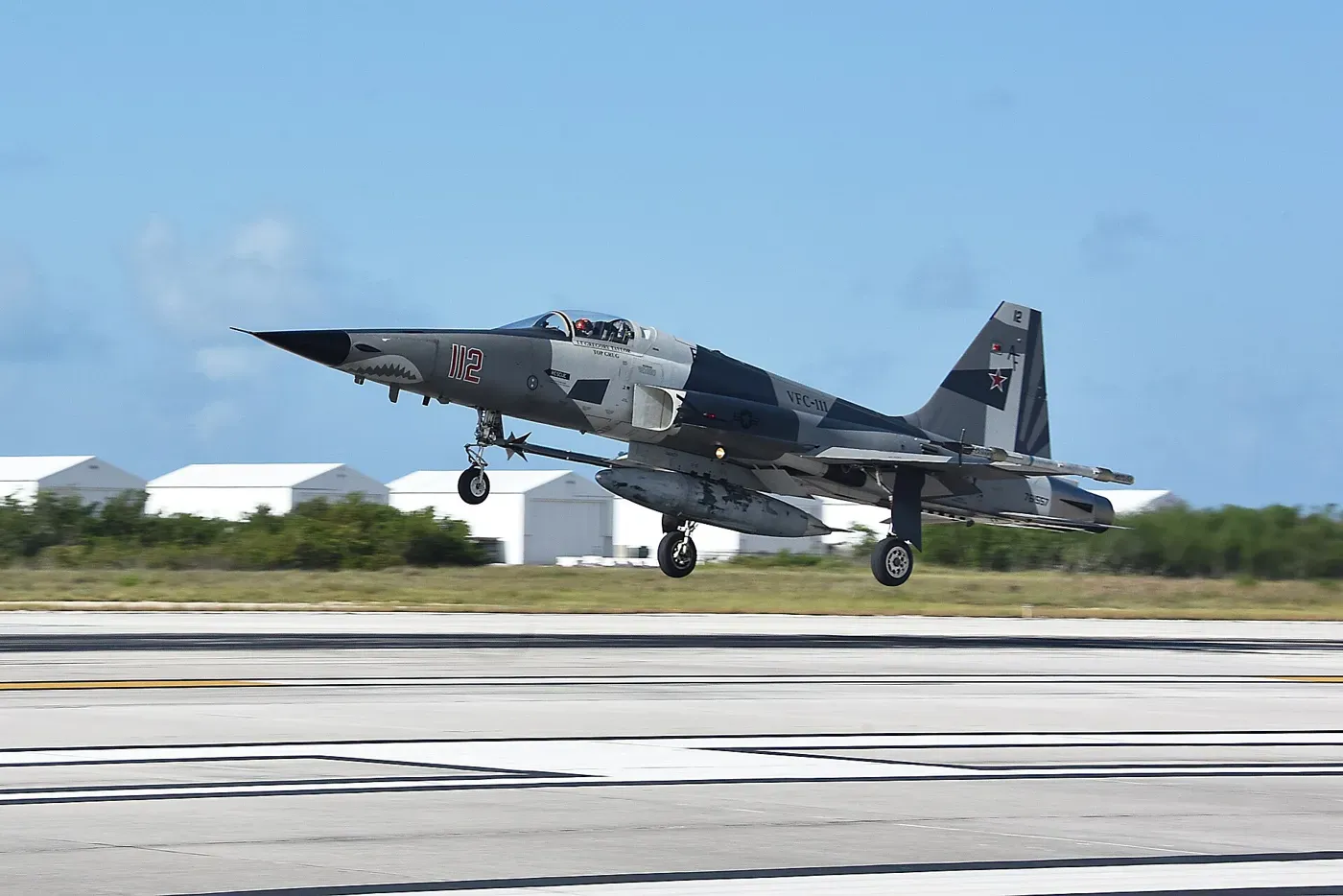
Each aircraft was flown from Emmen, Switzerland, to St. Augustine, Florida, inside a Navy C-130T. Northrop Grumman took in one jet a month for a five-month refurbishment. The NAVAIR program lead described the result as taking an old Navy F-5E and a newer Swiss airframe and ending up with a new aircraft, the F-5N. Of the 44, 41 became single-seat F-5Ns and three became two-seat F-5Fs. The final F-5N was delivered in April 2009, and the fleet was planned to fly until at least 2015.[1]
The "FrankenTiger"
The three two-seaters were literally stitched together. The Navy built them from the forward cockpit and tail sections of old Navy F-5Fs, mated to the newer center sections of former Swiss F-5Es. The first flew on November 25, 2008, and went to Marine squadron VMFT-401 in Yuma that December.[2][3]
The squadrons
Naval Air Station Fallon, Nevada. Provided adversary support for carrier air wings and was the Navy's F-5N program lead. In 2014 it reported 13 F-5Ns and one F-5F.[4]
Naval Air Station Key West, Florida. Formed in November 2006 from VFC-13's Key West detachment, it flew 17 F-5Ns and one FrankenTiger.[3][4]
Marine Corps Air Station Yuma, Arizona. The Marine Corps adversary unit received the first FrankenTiger in December 2008.[2]
A second Swiss buy
When the Navy needed more adversary aircraft, it went back to Switzerland. It bought 22 more F-5s, 16 F-5Es and 6 F-5Fs. In July 2022 Tactical Air Support received a $265 million contract to convert them from the Swiss configuration to a Navy and Marine Corps standard, with eight upgrades to existing fleet jets on the same contract.[5] NAVAIR finished the engineering phase in June 2022, and the aircraft then moved into modification.[6] Switzerland began handing the jets over afterward.[7]
Reading the paint
Adversary F-5s are known for blue, gray, brown and splinter camouflage that imitates potential opponents. That makes them popular with photographers and modelers, but it is also why paint is a trap for identification. A scheme can be reapplied, copied or kept on a museum aircraft long after the squadron retired it. To name the variant and unit, use the serial or Bureau Number, the tail code and a dated caption, the same checks we use to identify an F-5.
Want to try designing one? Head to the Paint Shop.
The Navy's adversary fleet keeps changing as newer aircraft take over some of the work. The squadron details above reflect the dated sources cited. Check current Navy or Marine Corps information before describing any unit's present-day equipment.
Last updated
Sources
- NAVAIR | Final F-5N Tiger II delivered to the Fleet (2009)
- U.S. Navy press release on the F-5F "Franken-Tiger" rollout, as reprinted by The North Spin
- Aviation Photo Digest | VFC-111 Sundowners
- Northern Skies Aviation | Tigers soar over Nevada (VFC-13, 2014)
- Defense Daily | $265 million contract to modify 22 Swiss F-5s
- Aviation Week | Former Swiss F-5E/Fs enter modification phase (July 2022)
- FlightGlobal | Switzerland begins turning over retired F-5s to the USA