
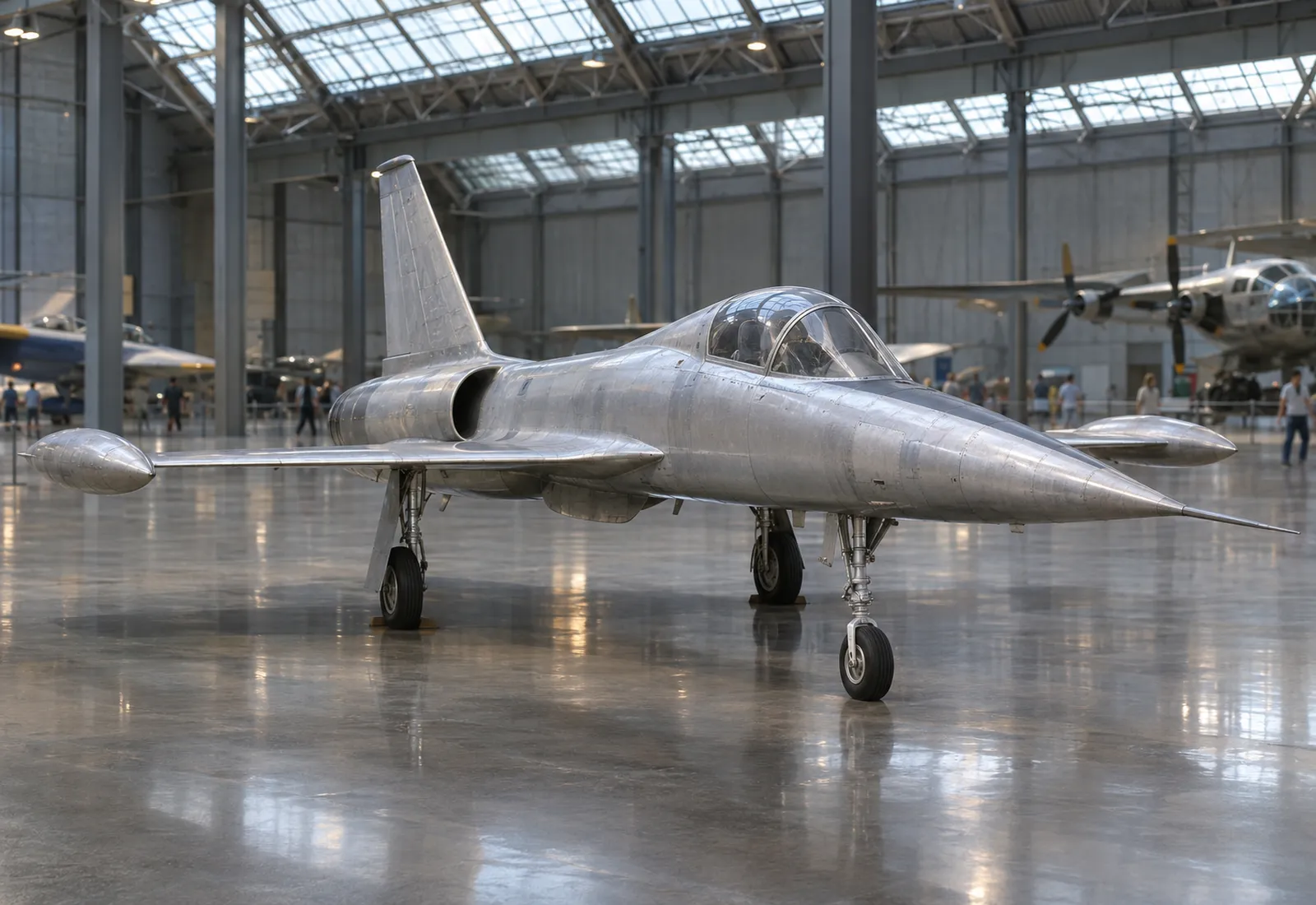
The museum identifies this as a YF-5A prototype. Its Skoshi Tiger paint represents another aircraft story, not this prototype's combat record. Production aircraft followed as the F-5A and the two-seat F-5B.
Identity
The National Museum of the U.S. Air Force identifies serial 59-4989 as one of three YF-5A prototypes ordered. It says the aircraft was delivered to the museum in 1970. [1]
Recorded history
Prototype program
One of three YF-5A prototypes ordered, according to the museum.
1970
Delivered to the National Museum of the U.S. Air Force.
Museum display
Painted to represent a Skoshi Tiger aircraft of the 4503rd Tactical Fighter Squadron. This scheme describes the display, not this prototype's own combat record.
The museum says its YF-5A is painted as a Skoshi Tiger. A visitor could mistake those markings for this airframe's service history. The aircraft identity and the commemorative scheme are separate facts.
Its two brothers
59-4989 was the last of three prototypes. The first, 59-4987, was unveiled on 30 May 1959 in front of visitors from 40 countries, and two months later Northrop test pilot Lew Nelson took it supersonic on its very first flight at Edwards Air Force Base. It now hangs in the Museum of Flight in Seattle. The second, 59-4988, was used for rough-field trials on grass runways.
Tests on the first two showed the wing needed to be stronger and carry another weapons station. Those changes went into 59-4989, which became in effect the first production F-5A. That makes the museum's jet the real starting point of the F-5A line.
Last updated
Source and limits
National Museum of the U.S. Air Force | Northrop YF-5A Freedom Fighter. This record follows the museum's published description. It does not claim a full movement or maintenance history.
How to read this record
Serial and operator records establish which aircraft this page follows.
Model, equipment and markings may change during one airframe's life.
Display or operating status is dated because aircraft can move.
A photographed paint scheme is supporting evidence, not proof of identity by itself.