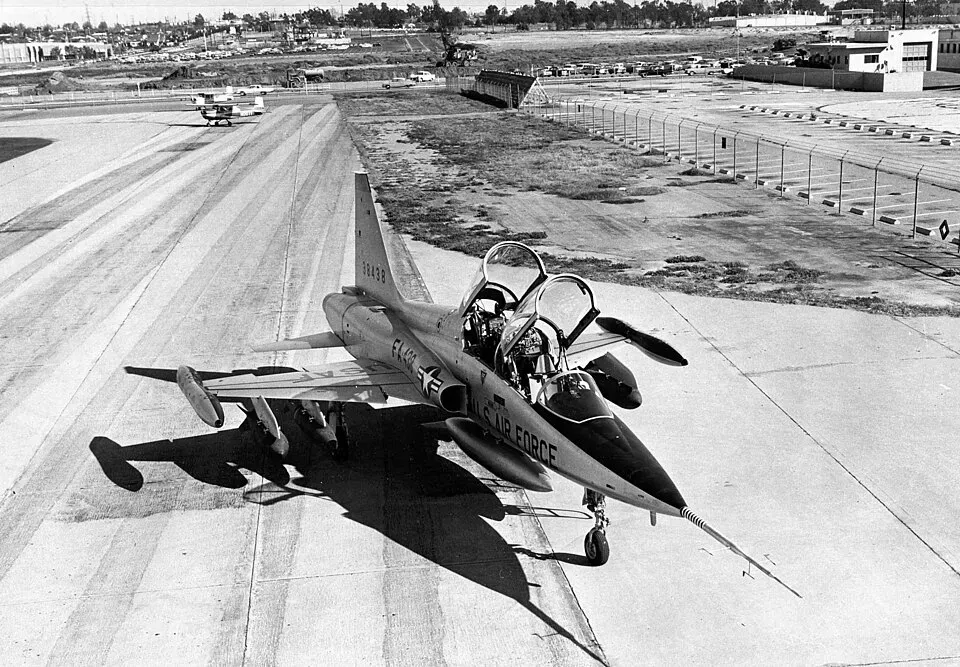
- Two seats
- Early Freedom Fighter family
- Compare with the later F-5F
Two seats narrow the choice but cannot by themselves separate an F-5B from an F-5F.
Work through the identification stepsThe F-5B put two seats in the early Freedom Fighter family. It served as a trainer while retaining combat capability, according to Pima Air and Space Museum. It belongs beside the single-seat F-5A, before the later Tiger II redesign.
At a glance
| Family | Freedom Fighter |
|---|---|
| Crew | Two |
| Related single-seat model | F-5A |
| Role | Training with combat capability |
What the second seat changed
The second cockpit let an instructor fly with a student in an F-5-family aircraft. Pima describes the F-5B as a two-seat trainer that was also capable of combat operations. Its record of serial 72-0441 shows how one aircraft moved through training assignments and later became a ground-training airframe. Those dates describe that particular aircraft, not every F-5B. [1]
A T-38 cockpit on an F-5A airframe
The F-5B paired the tandem two-seat cockpit of the T-38 Talon with the F-5A airframe, keeping the fighter's underwing stations, wing-root extensions and larger intakes. The nose guns did not carry over.[3] The prototype first flew on 24 February 1964.[2][3] Northrop built 200 F-5Bs, gunless but otherwise combat-capable, alongside 624 single-seat F-5As.[4]
The school for the world's F-5 pilots
F-5 deliveries to Tactical Air Command began in April 1964, to train foreign pilots who would fly the type at home.[2] The first five F-5Bs went that month to the 4441st Combat Crew Training School at Williams Air Force Base in Arizona, joined by seven F-5As in August.[3] For many allied pilots, then, the first F-5 they flew had two seats.
F-5B or F-5F?
| Feature | F-5B | F-5F |
|---|---|---|
| Family | Freedom Fighter | Tiger II |
| First flight | February 1964 | September 1974 |
| Nose gun | None | One M39 cannon |
Sources: [2][4] and the F-5F page, which also covers its stretched forward fuselage.
How to recognize one
Two tandem cockpit positions are the first clue. That also describes the later F-5F, so check the rest of the airframe and the caption. A documented serial and operator are stronger evidence than canopy shape alone. Use the identification steps when comparing a photograph.
Serial 72-0441 has a museum-backed service timeline. The Pima aircraft record includes a photograph and specifications for that airframe.
Last updated
Sources and scope
- Pima Air and Space Museum | Northrop F-5B
- National Museum of the U.S. Air Force | Northrop YF-5A Freedom Fighter
- Northrop F-5, German Wikipedia (F-5B section)
- Northrop F-5, Wikipedia
Published specifications on the museum page describe its recorded aircraft. Equipment and performance can differ across operators and configurations.